

Automatic Doorway Spill Barrier BL/BED-PM
Closes automatically on a spill, a fire alarm or the push of a button. Mounted on the floor surface, so no trench or pit is needed.
AUTOMATIC DOORWAY SPILL BARRIER
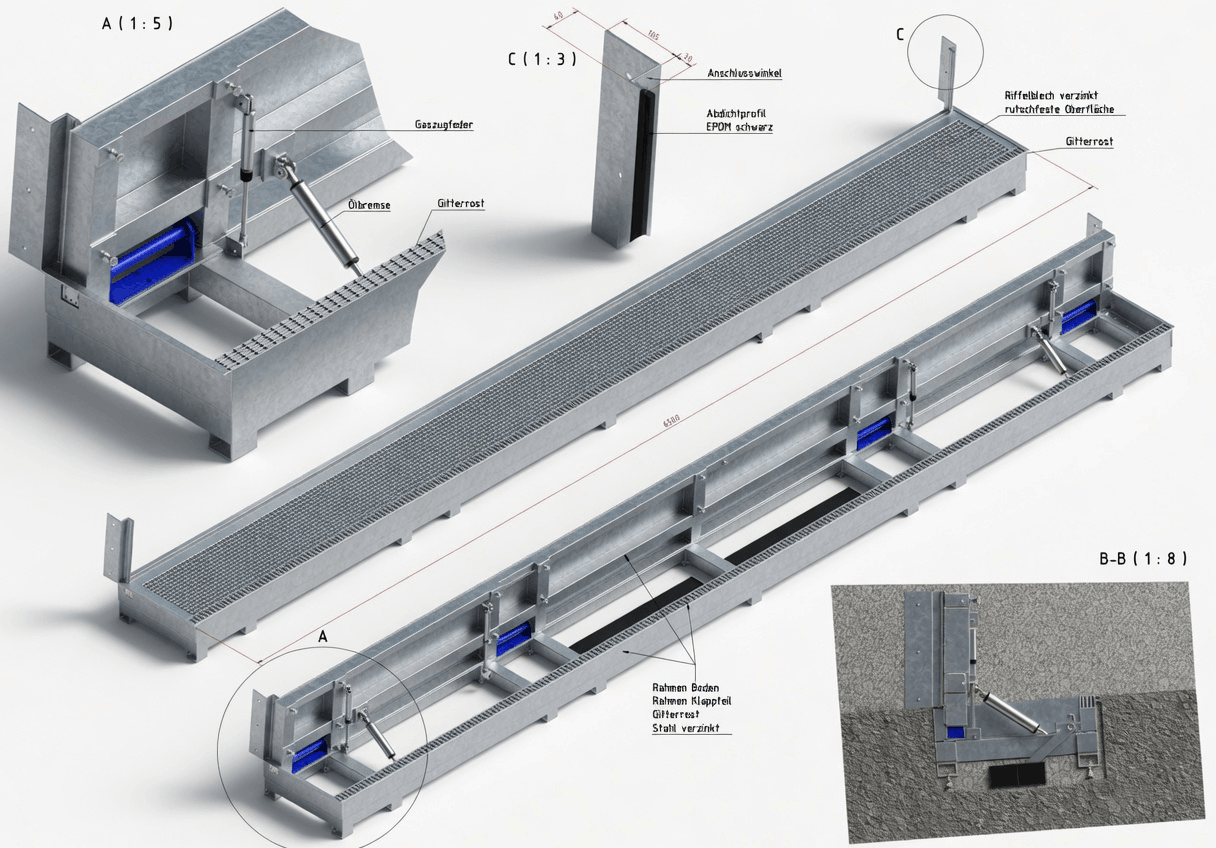
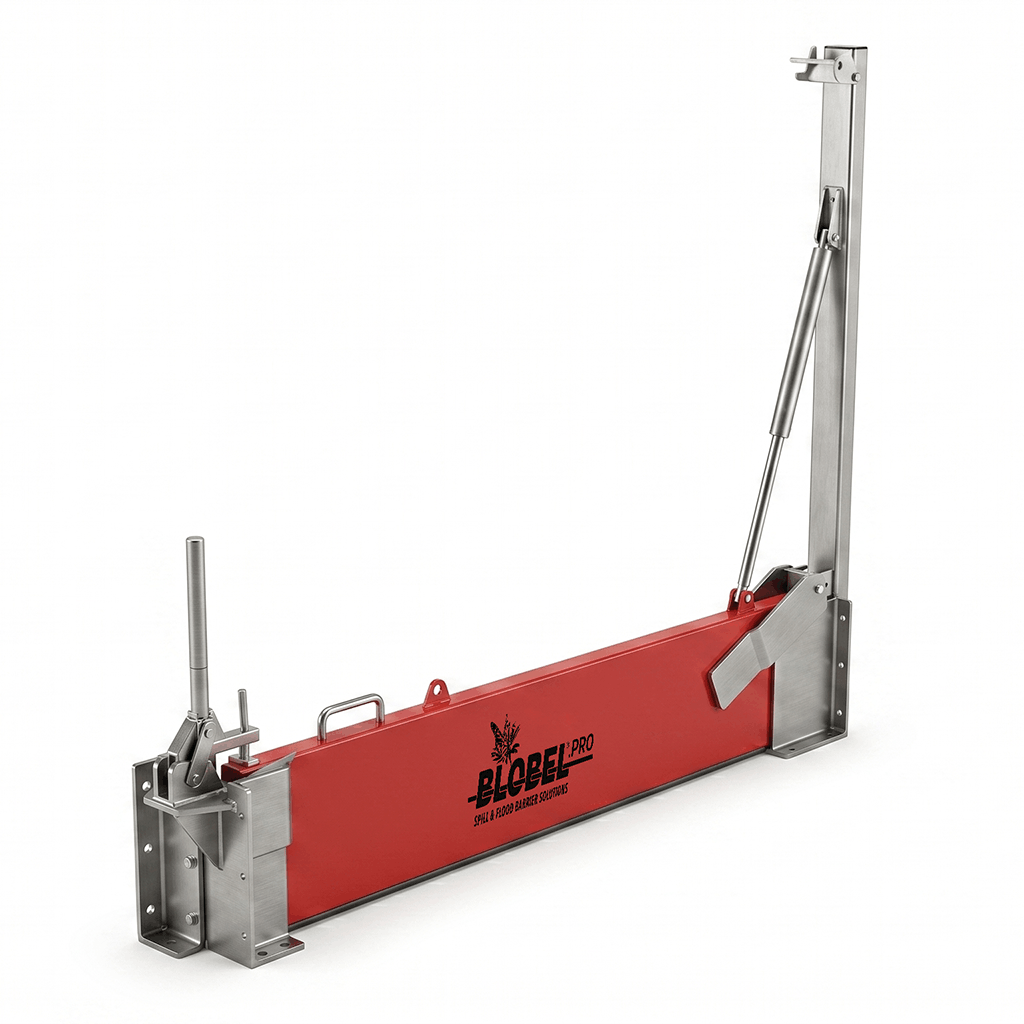
The BL/BED-PM is an automatic doorway spill barrier. It closes automatically when a spill is detected, when the fire alarm goes off, or at the push of a button. Spilled chemicals and fire water stay inside. It mounts on the floor surface, so no trench or pit is needed.
- Opening width: up to 6,000 mm as standard, wider on request
- Retention height: 100 to 1,000 mm
- What makes it close: fire alarm panel, leak detectors, flow meters or a push button
- Fail-safe: it closes when the 24 V DC control signal is lost, so a cut cable or a longer power loss also closes the barrier
- Mounting: on the floor surface, no trench or pit; the floor may be uneven by up to 10 mm
- Explosive areas: ATEX zones 0, 1, 2, 20, 21 and 22; US Class I and II, Division 1 and 2
- Leak test: 0 ml per meter per hour in a 2018 independent test to the VdS 2564-1 method (the limit is 50)
- Warnings: horn as standard; warning light and closing stop as options
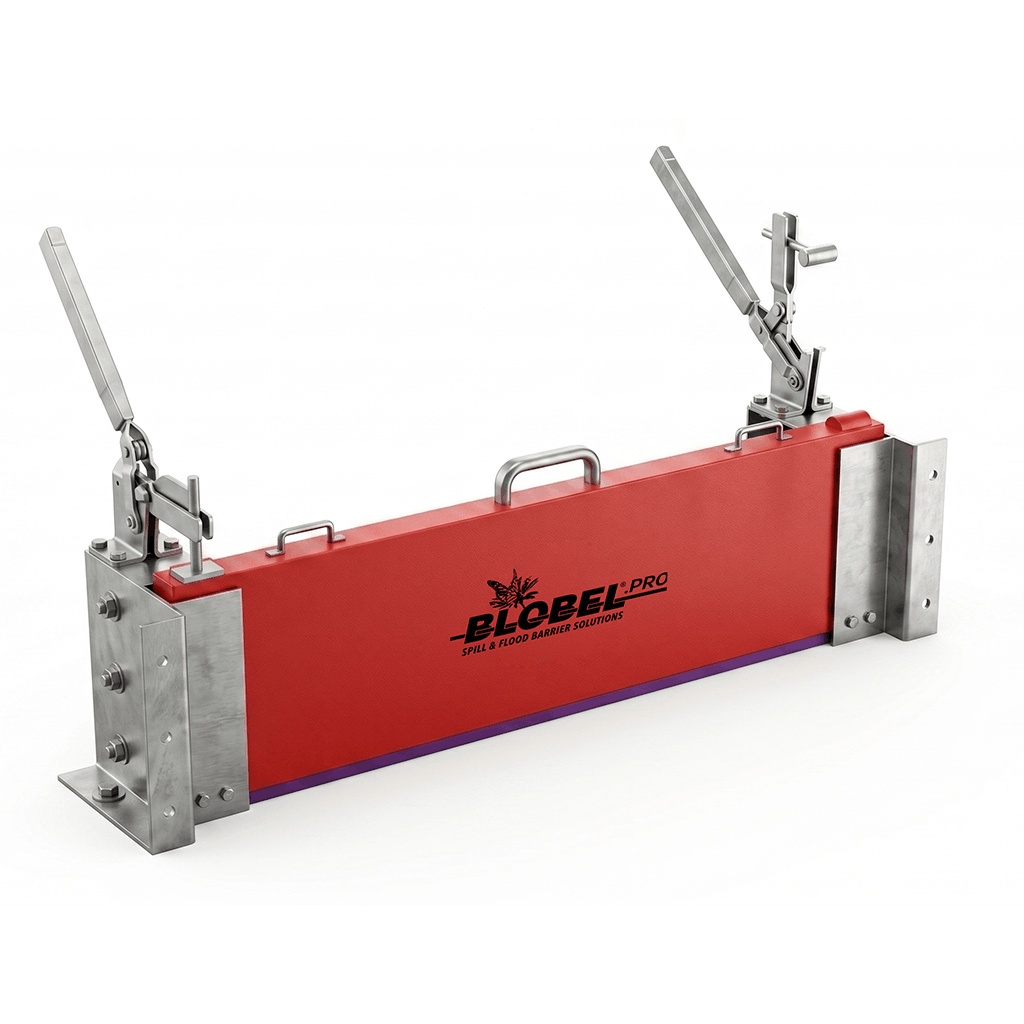
- Barrier body and seal: trapezoidal hollow aluminum profile with a compressible seal that resists chemicals, aging and fire
- Finish: powder coated in signal red (RAL 3020); other metal parts galvanized or aluminum
- Closing time: 30 to 60 seconds recommended; the closing speed is adjustable
- Maintenance: every 3 months: a visual check and a test run (press the button, let it close, raise it again)
- Warranty: 12 months
- Lead time (USA): 8 to 12 weeks plus shipping
- Installation (USA): by your contractor with BLOBEL's instructions, or by a BLOBEL partner where one is available
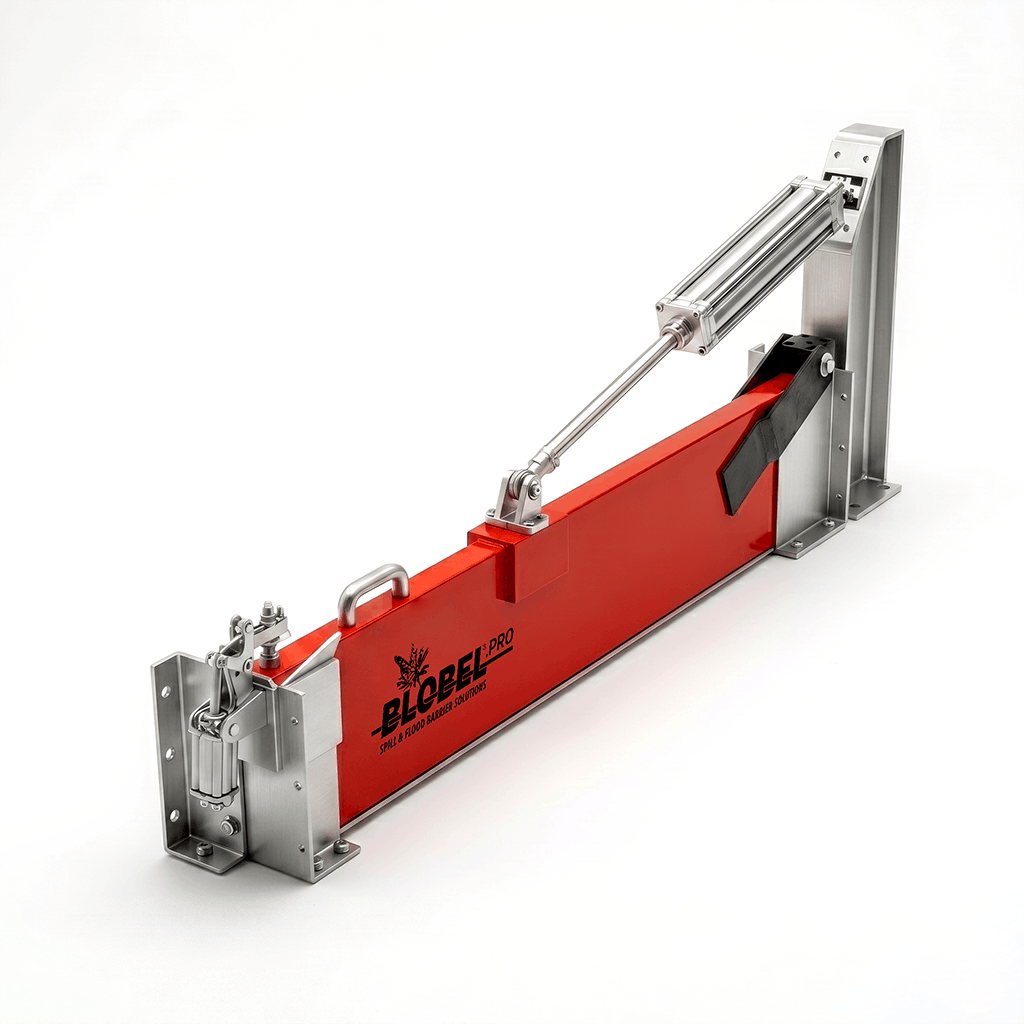
HOW IT WORKS
Four steps, from standby beside the door to a liquid-tight seal and a controlled reset.
Standby
The barrier body stands upright on its hinge next to the opening. People, pallet trucks and forklifts use the door as usual, and nothing lies on the floor in their way.
Signal
The fire alarm panel, a leak detector or a flow meter drops the 24 V DC control signal, or someone presses the button in the control cabinet. If the signal is lost for any other reason, the barrier closes as well.
Close and seal
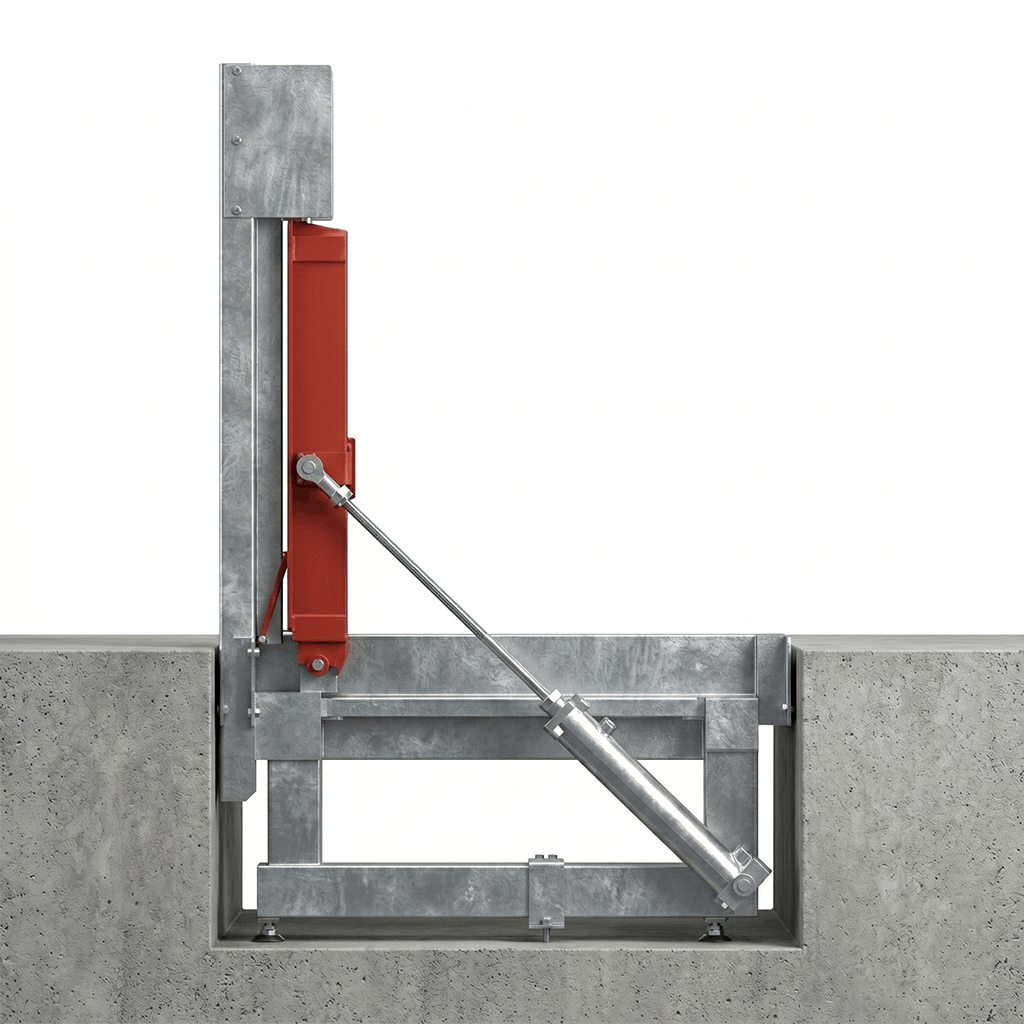
A pneumatic cylinder closes the barrier across the door opening. A final pneumatic clamp then presses the seal onto the floor so it is liquid-tight. The air circuit works in two stages. The closing move runs at a low pressure of 3 to 5 bar to protect anyone standing in its path.
Reset
When the danger is over, the barrier opens only after a controlled reset, which makes sure all is clear before it rises. After the reset it returns to standby, ready for the next alarm.
WHERE IT IS USED
Wherever spilled chemicals or contaminated fire water must stay inside the room.
Chemical and hazardous goods stores
A leaking drum or a burst container stays in the store room. The liquid cannot run into the next hall, into floor drains or out of the building.
Sprinklered warehouses
When the sprinklers or the fire department put out a fire, the water picks up whatever was stored in the building. The barrier keeps that contaminated fire water inside so it can be pumped out and treated.
Doors with forklift and truck traffic
The barrier stands beside the opening, not in it. Overhead doors and busy dock doors stay fully usable until the moment of an alarm. Forklifts and trucks drive through as usual.
Rooms with explosion risk
With an explosion-proof (Ex) solenoid valve and an air control signal, the barrier can be installed in ATEX zones and in US Class I and II hazardous locations.
Foam extinguishing systems
At L'Oréal warehouses in Great Britain the barriers close the entrances so the extinguishing foam stays where the fire is.
SIZES AND SPECIFICATIONS
Standard sizes from the BL/BED-PM datasheet. Barrier length = clear door width + extra length ZED. Minimum clear height = barrier length + H + 150 mm.
| Retention height H (mm) | H (inches) | Extra length ZED (mm) | ZED (inches) |
|---|---|---|---|
| 100 | 3.94 | 195 | 7.68 |
| 150 | 5.91 | 245 | 9.65 |
| 200 | 7.87 | 295 | 11.61 |
| 250 | 9.84 | 355 | 13.98 |
| 300 | 11.81 | 405 | 15.94 |
| 350 | 13.78 | 465 | 18.31 |
| 400 | 15.75 | 530 | 20.87 |
| 450 | 17.72 | 595 | 23.43 |
| 500 | 19.69 | 655 | 25.79 |
| 550 | 21.65 | 720 | 28.35 |
| 600 | 23.62 | 785 | 30.91 |
| 650 | 25.59 | 845 | 33.27 |
| 700 | 27.56 | 910 | 35.83 |
| 750 | 29.53 | 975 | 38.39 |
| 800 | 31.50 | 1035 | 40.75 |
| 850 | 33.46 | 1100 | 43.31 |
| 900 | 35.43 | 1165 | 45.87 |
| 950 | 37.40 | 1225 | 48.23 |
| 1000 | 39.37 | 1290 | 50.79 |
RULES IT HELPS YOU MEET
Leak testing, fire codes, explosion protection and local inspection.
Fire water retention (VdS 2564)
The BL/BED-PM was leak tested to the VdS 2564-1 method that is used for fire water retention systems. The warning light and closing stop that VdS 2564 asks for are available as an upgrade.
US fire codes and insurers
US customers usually buy the BL/BED-PM to meet NFPA requirements or the requirements of their insurer. Your local fire inspector and your insurer decide which rules apply to your site.
Explosion protection
Versions with an explosion-proof solenoid valve meet ATEX 2014/34/EU and the US National Electrical Code articles 500 and 505 for hazardous locations.
Local inspection
On a project in Minnesota, BLOBEL worked with the general contractor, the factory owner and the local inspector, and the barriers passed every safety and inspection check.
PROJECTS
Installations in the USA and Great Britain.
Two automotive warehouses, Virginia, USA
16 automatic barriers: BL/BED-PM2 on overhead doors, BL/BDD-PM2 on low-ceiling doors and BL/BED-AS on personnel doors.
Manufacturing plant, Minnesota, USA
Automatic BL/BED-PM2 and BL/BED-AS barriers plus manual BL/BED barriers, signed off by the local inspector.
L'Oréal warehouses, Great Britain
Entrances close fully automatically for foam extinguishing, on a reduced-pressure safety circuit of 3 to 5 bar to protect staff.
WHICH BARRIER DO I NEED?
BLOBEL automatic and manual doorway barriers for different door types.
| Model | Best for |
|---|---|
| BL/BED-PM | Standard and overhead doors, fully automatic |
| BL/BED-AS | Personnel doors (mandoors), automatic |
| BL/BDD-PM | Overhead doors with a low ceiling, or very wide openings, automatic |
| BL/BDD-U-PM | Loading docks with deck levelers, automatic |
| BL/BED | The same pivot design, closed by hand, for low-traffic doors |
QUESTIONS BUYERS ASK
Short answers about safety, the seal, installation and delivery.
It is a barrier that stands beside a door and closes automatically when a spill or a fire is detected, so the liquid stays in the room. The BL/BED-PM closes across the opening and seals against the floor.
A drop in its 24 V DC control signal. The fire alarm panel, leak detectors, flow meters or a push button can cause that drop. Yes, it is fail-safe: it also closes if the signal is lost, for example after a cable break or a longer power loss.
No. It is mounted on the floor surface. The floor may be uneven by up to 10 mm: concrete, checker plate, tiles and stone all work. With no pit, there is nothing that resin or debris can clog and no place where vapors collect.
In the USA, plan on 8 to 12 weeks plus shipping. Your own contractor installs it with BLOBEL's instructions, or a BLOBEL partner where one is available. Standard sizes go up to 6,000 mm wide and 1,000 mm high.
While it closes, the barrier runs on a low-pressure circuit of 3 to 5 bar, and a horn warns people nearby. A flashing warning light can be added.
In a 2018 independent leak test to the VdS 2564-1 method, the BL/BED-PM let through 0 ml per meter per hour. The limit for that test is 50. Ask us for the test report.
Yes. With an explosion-proof (Ex) solenoid valve it is approved for ATEX zones 0, 1, 2, 20, 21 and 22 and for US Class I and II, Division 1 and 2 locations. In those areas it is controlled by air instead of an electric signal.
Use the BL/BED-PM for standard and overhead doors. For personnel doors choose the BL/BED-AS, for low ceilings the BL/BDD-PM and for loading docks with deck levelers the BL/BDD-U-PM. For low-traffic doors, the manual BL/BED is the lower-budget option.
Get a quote for your doorway
Send us the door size and the liquid you need to contain. A BLOBEL engineer will reply within one working day with questions or a proposal. Prices are on request, because they depend on the door, the location and the local contractor.
A Proposal for Your Door
Reply Within One Working Day
A BLOBEL engineer replies with questions or a proposal.
Prices on Request
The price depends on the door, the location and the local contractor.